Social marketing does not require any experience or specialized knowledge. The people you meet at Nature’s Sunshine will teach you how to run this business for free. You will see that it is simple, and everything depends on your commitment. This business does not require significant investments from you. If you are convinced of our products, all you have to do is use them. That’s all!
When, thanks to you, your relatives and friends also start using these products, you will earn your first bonuses, and when this group grows, you will be able to say: “I run my own business!”
MLM - Network Marketing - Multi-Level-Marketing
At the very beginning you need to register
by clicking the button below:
* Registration is free and non-binding - you don't pay anything, you don't have to do anything!
- You collect points for which you can get a discount or get free products that you can sell.
- By recommending NSP and products, you build a group and have the opportunity to obtain additional points and discounts.
- Quick promotion bonus – intended for Distributors who dynamically develop their business.
- Registration is free and non-binding – you don’t pay anything, you don’t have to do anything!
If you have your own business,
first create an account by clicking the button below:
* Registration is free and non-binding - you don't pay anything, you don't have to do anything!
The Quick Promotion Bonus is intended for Distributors who dynamically develop their business.
Each status (starting with the Leader status) has an assigned number of months within which it must be achieved to receive an additional bonus. To receive the bonus, you must qualify for the appropriate status and confirm it three times in the months immediately after achieving this status.- Leader – PLN 600 – promotion within 3 months from the date of registration
- Leader-Assistant – PLN 1,000 – promotion within 6 months from the date of registration
- Leader-Consultant – PLN 3,000 – promotion within 9 months from the date of registration
- Leader-Manager – PLN 6,000 – promotion within 12 months from the date of registration*
- Director-Assistant – PLN 15,000 – promotion within 24 months from the date of registration*
- Director-Consultant – PLN 15,000 – promotion without time limit
- Director-Manager – PLN 30,000 – promotion without time limit
- Member of the Board of Directors – PLN 75,000 – promotion without time limit
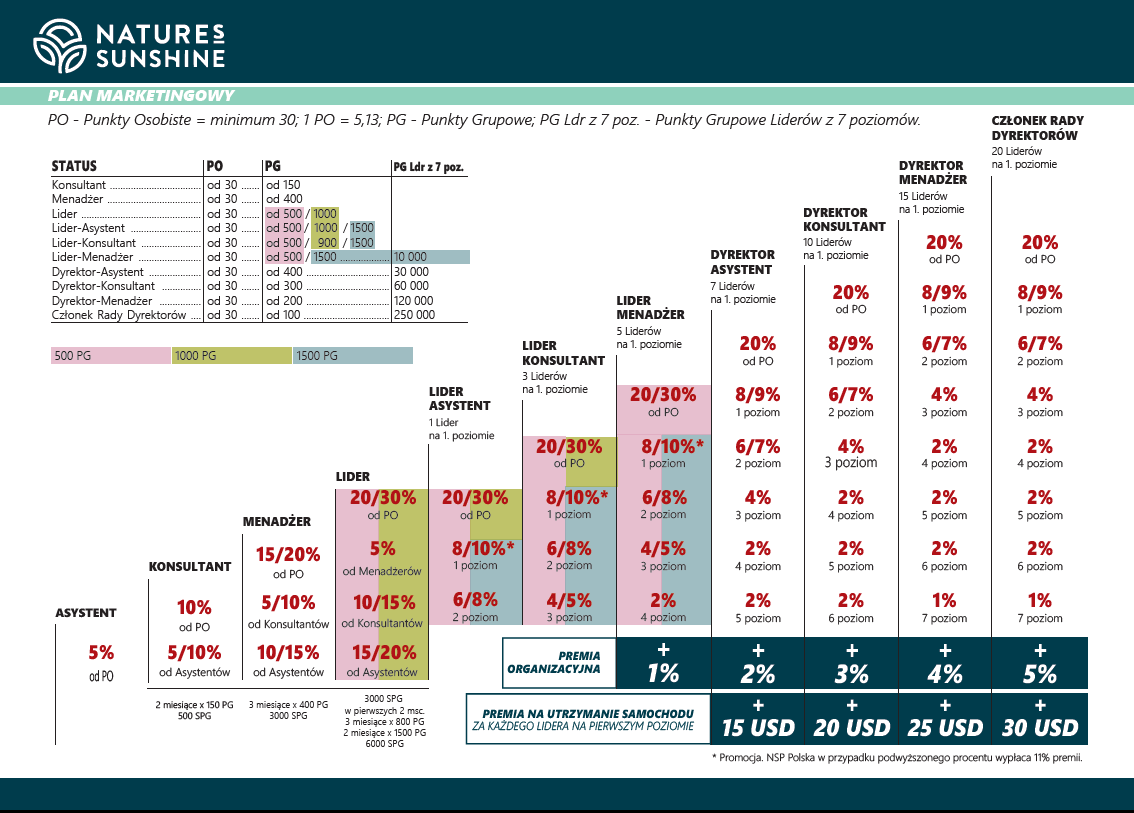

Where to start?
Do you have a favorite restaurant? Do you mostly enjoy shopping in the same store? You’ve probably talked about it with your friends many times? Have you told them about Nature’s Sunshine?
Start there. Share your knowledge about our products. Tell us why you found our dietary supplements to be the best. There are people among your friends who already eat consciously. Be sure to recommend Nature’s Sunshine to them. If you are not sure if you can do this, ask your sponsor for help. He will definitely be happy to meet with you and help.

What's next?
One of your friends will definitely decide to join you. Organize meetings together to talk about Nature’s Sunshine. Talk about the products and opportunities offered by NSP during social meetings. Remember! Every contact is important, so if you are still not sure of your skills, ask a sponsor for help.

That's all! You run your own business. Get involved! There are no limits here!
Follow the lead of the person who recommended Nature’s Sunshine to you. Network marketing is really simple and all you need to do is listen carefully and follow your sponsor’s advice. He’s already successful. It’s time for you! Anyone can succeed in this business. There are no people among your friends who are not suitable for network marketing. There are no people there who don’t want to be healthy and rich. You can recommend Nature’s Sunshine to anyone. You never know who will be your best business partner.
Why is it worth working with Nature's Sunshine Products?
At Nature’s Sunshine, we improve life thanks to nature and the opportunities we give to everyone who wants to develop with us. First of all, we help you change your lifestyle by providing the highest quality dietary supplements, but we also provide opportunities for personal development and running your own business.
Join Nature's Sunshine - a team of ambitious, successful people!
Unlocking the Potential of MLM: A British Perspective
The multi-level marketing (MLM) industry in the United Kingdom has attracted considerable attention over recent decades, developing into a multifaceted sector that combines entrepreneurial activity with direct sales operations. Fundamentally, MLM functions as a business model wherein salespeople generate income through two channels: direct product sales and the recruitment of additional participants into the organisation. This arrangement establishes a hierarchical framework in which individuals earn commissions derived from sales generated by their recruits, commonly termed their “downline.” The MLM model appeals to participants through its proposition of financial autonomy and operational flexibility, permitting individuals to work from domestic locations whilst maintaining control over their working hours.
Within the UK, the MLM sector has experienced notable expansion, particularly amongst those pursuing supplementary income opportunities. The proliferation of social media platforms and digital marketing technologies has accelerated this expansion, facilitating individuals in accessing broader audiences and establishing networks with greater efficiency than previously possible. Nevertheless, the industry remains subject to significant scrutiny.
Detractors frequently emphasise the inherent risks of participant exploitation and the substantial attrition rates observed amongst members, which have contributed to comparisons between MLM operations and pyramid schemes. Comprehending these structural characteristics is essential for individuals seeking to engage effectively with the MLM sector in Britain.
Summary
- MLM in Britain operates within a strict legal and regulatory framework to protect consumers and ensure fair practices.
- Modern MLM business models increasingly leverage technology and social media to expand reach and engagement.
- Overcoming negative stereotypes is crucial for building trust and credibility in the British MLM market.
- Comprehensive training and ongoing support are key factors in achieving MLM success in the UK.
- Emerging trends and consumer protection measures will shape the future growth and sustainability of MLM businesses in Britain.
The Legal and Regulatory Landscape of MLM in the UK
The legal framework governing MLM in the UK is primarily shaped by consumer protection laws and regulations aimed at preventing fraudulent practices. The UK operates under strict guidelines set forth by the Competition and Markets Authority (CMA) and the Advertising Standards Authority (ASA), which oversee business practices to ensure transparency and fairness. These regulations are designed to protect consumers from misleading claims and ensure that MLM companies operate within ethical boundaries.
For instance, any income claims made by MLM participants must be substantiated with evidence, preventing exaggerated promises that could mislead potential recruits. Moreover, the UK has specific legislation that addresses pyramid schemes, which are illegal. The distinction between legitimate MLM operations and pyramid schemes is critical; while MLMs focus on product sales, pyramid schemes primarily rely on recruitment for income.
This legal backdrop necessitates that MLM companies in Britain maintain clear records of sales and recruitment practices, ensuring compliance with the law. Companies must also provide clear information about their compensation structures, allowing potential recruits to make informed decisions about their involvement.
The Evolution of MLM Business Models in Britain
The evolution of MLM business models in Britain reflects broader changes in consumer behaviour and technological advancements. Initially, many MLM companies operated through traditional face-to-face interactions, relying heavily on home parties and personal networks to drive sales. However, as digital technology advanced, so too did the strategies employed by these companies.
The introduction of e-commerce platforms allowed for a more streamlined approach to sales, enabling representatives to sell products online and reach customers beyond their immediate geographical area. In recent years, there has been a notable shift towards hybrid models that combine both online and offline strategies. This evolution has been particularly evident during the COVID-19 pandemic when many traditional sales methods were disrupted.
Companies adapted by enhancing their online presence, utilising social media platforms for marketing and recruitment purposes. This shift not only expanded their reach but also attracted a younger demographic that is more comfortable with digital communication. As a result, modern MLM businesses in Britain are increasingly characterised by their agility and ability to adapt to changing market conditions.
Leveraging Technology and Social Media in MLM
The integration of technology and social media into the MLM industry has transformed how businesses operate and how representatives engage with potential customers and recruits. Platforms such as Facebook, Instagram, and TikTok have become essential tools for MLM participants, allowing them to showcase products, share personal success stories, and build communities around their brands. This shift towards digital marketing has enabled representatives to create engaging content that resonates with their audience, fostering a sense of connection that was previously difficult to achieve through traditional methods.
Moreover, technology has facilitated the development of sophisticated training and support systems within MLM companies. Many organisations now offer online training modules, webinars, and virtual meetings that provide representatives with the skills and knowledge necessary to succeed. This access to resources not only empowers individuals but also enhances their ability to navigate the complexities of the market.
As technology continues to evolve, it is likely that we will see even more innovative approaches to marketing and recruitment within the MLM sector.
Overcoming Misconceptions and Stereotypes about MLM in the UK
| Metric | Description | Example Value | Unit |
|---|---|---|---|
| Recruitment Rate | Number of new members recruited per month | 150 | Members/Month |
| Average Sales per Member | Average monthly sales generated by each member | 1200 | GBP |
| Retention Rate | Percentage of members retained month-over-month | 75 | % |
| Commission Rate | Percentage of sales paid as commission to members | 10 | % |
| Average Downline Size | Average number of recruits under each member | 5 | Members |
| Monthly Revenue | Total revenue generated by the MLM network per month | 180000 | GBP |
Despite its growth and evolution, the MLM industry in Britain is often plagued by misconceptions and negative stereotypes. Many people associate MLM with high-pressure sales tactics or view it as a scheme designed to exploit vulnerable individuals seeking financial stability. These perceptions can deter potential recruits from exploring legitimate opportunities within the industry.
To combat these stereotypes, it is essential for both companies and representatives to promote transparency and ethical practices. One effective strategy for overcoming misconceptions is through education. By providing clear information about how MLM works, including its potential risks and rewards, companies can help demystify the industry for sceptics.
Success stories from reputable representatives can also serve as powerful testimonials that challenge negative perceptions. Additionally, fostering a culture of support and collaboration within MLM networks can help create a more positive image of the industry as a whole.
Building a Successful MLM Business in Britain
Building a successful MLM business in Britain requires a combination of strategic planning, effective marketing, and strong interpersonal skills. One of the first steps for aspiring representatives is to choose a reputable company with a solid track record and ethical business practices.
Researching various options can help individuals identify organisations that align with their values and offer quality products or services.
Once affiliated with a company, representatives must develop a robust marketing strategy that leverages both online and offline channels. This may involve creating engaging content for social media platforms, hosting virtual events or webinars, and utilising email marketing campaigns to nurture leads. Networking plays a crucial role in building a successful MLM business; establishing relationships with potential customers and recruits can lead to increased sales and team growth.
Additionally, setting realistic goals and tracking progress can help individuals stay motivated and focused on their objectives.
The Importance of Training and Support in MLM
Training and support are vital components of success in the MLM industry. Many companies recognise this need and invest in comprehensive training programmes designed to equip representatives with the skills necessary for effective selling and recruitment. These programmes often cover various topics, including product knowledge, sales techniques, marketing strategies, and personal development.
Support systems within MLM networks can also significantly impact an individual’s success. Mentorship from experienced representatives can provide invaluable insights into navigating challenges and maximising opportunities within the business. Furthermore, fostering a sense of community among team members can enhance motivation and accountability, creating an environment where individuals feel empowered to achieve their goals.
Navigating the Challenges of MLM in the British Market
While there are numerous opportunities within the MLM industry in Britain, representatives must also navigate various challenges that can arise. One significant hurdle is competition; as more individuals enter the market, standing out becomes increasingly difficult. To overcome this challenge, representatives must differentiate themselves by developing unique selling propositions that highlight their personal brand or approach.
Another challenge is managing customer relationships effectively. Building trust with potential customers is essential for long-term success; therefore, representatives must prioritise transparency and authenticity in their interactions. Additionally, dealing with rejection is an inevitable part of the sales process; developing resilience and maintaining a positive mindset can help individuals persevere through setbacks.
The Role of Consumer Protection in MLM
Consumer protection plays a crucial role in ensuring that MLM companies operate ethically and transparently within the British market. Regulatory bodies such as the Competition and Markets Authority (CMA) enforce guidelines that prevent misleading advertising practices and protect consumers from fraudulent schemes. These regulations require companies to provide clear information about their products, compensation structures, and any associated risks.
Furthermore, consumer protection laws empower individuals to report unethical practices or seek recourse if they feel they have been misled or exploited. This framework not only safeguards consumers but also promotes accountability within the MLM industry itself. Companies that prioritise ethical practices are more likely to build trust with their representatives and customers alike.
The Future of MLM in Britain: Trends and Opportunities
The future of the MLM industry in Britain appears promising as it continues to adapt to changing consumer behaviours and technological advancements. One notable trend is the increasing emphasis on sustainability and ethical sourcing within product offerings. Consumers are becoming more conscious of their purchasing decisions, favouring companies that align with their values regarding environmental responsibility.
Additionally, as remote work becomes more prevalent, individuals may seek flexible income opportunities through MLM as an alternative to traditional employment models. This shift could lead to an influx of new participants entering the industry, further diversifying its landscape. Companies that embrace innovation—whether through enhanced digital marketing strategies or unique product offerings—are likely to thrive in this evolving market.
Success Stories and Case Studies in British MLM
Numerous success stories within the British MLM industry exemplify how individuals have transformed their lives through dedication and strategic efforts.
For instance, one prominent case involves a representative who started with minimal experience but leveraged social media platforms effectively to build a substantial following.
By sharing her personal journey and product experiences authentically, she was able to cultivate trust among her audience, leading to significant sales growth.
Another inspiring example comes from a team of representatives who collaborated on joint marketing initiatives, pooling their resources to host larger events that attracted potential recruits from diverse backgrounds. Their collective efforts not only increased brand visibility but also fostered a supportive community that encouraged individual growth within the team. These case studies highlight the potential for success within the MLM industry when individuals embrace innovative strategies while remaining committed to ethical practices.
FAQhttps://nsnatura.pl/en/cooperation/
MLM stands for Multi-Level Marketing, a business model where individuals sell products directly to consumers and earn commissions from their own sales as well as from the sales made by people they recruit into the business.
In MLM, participants earn money through direct sales of products and by recruiting new members into the organisation. Commissions are earned not only on personal sales but also on the sales made by recruits, creating multiple levels of compensation.
No, MLM is a legitimate business model focused on selling products or services. However, some MLMs may operate similarly to pyramid schemes if they emphasise recruitment over product sales. Pyramid schemes are illegal in the UK.
Yes, MLM companies are legal in the UK provided they comply with consumer protection laws and do not operate as pyramid schemes. They must focus on genuine product sales rather than recruitment incentives.
MLM companies often sell health and wellness products, cosmetics, household goods, and personal care items. The product range varies widely depending on the company.
Risks include financial loss, as many participants do not earn significant income. There can also be pressure to recruit others, and some MLMs may have high start-up costs or require purchasing inventory.
A legitimate MLM will have a clear product or service, transparent compensation plan, no emphasis on recruitment over sales, and compliance with UK laws. Researching the company’s reputation and reviews is advisable.
While some individuals do earn a full-time income from MLM, the majority earn little or no profit. Success often requires significant time, effort, and sales skills.
Consider the company’s product quality, compensation plan, start-up costs, time commitment, and your ability to sell and recruit. It is also important to understand the legal and financial implications.
Information about MLM regulations can be found through the UK’s Competition and Markets Authority (CMA) and the Advertising Standards Authority (ASA), which oversee fair trading and advertising practices.